
A lasting commitment to peace and solidarity - On the 50th anniversary of the legal registration of the CPPC
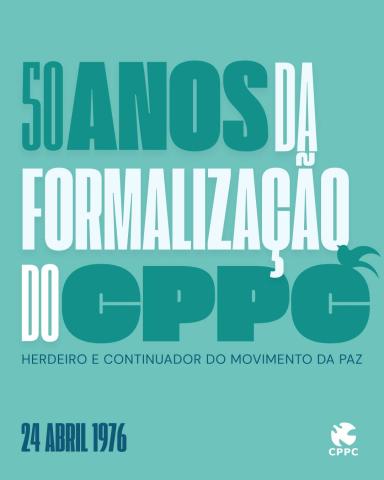
On April 24, 1976, 50 years ago today, a group of peace activists freely registered the Portuguese Council for Peace and Cooperation (CPPC), thus formalizing what had long been a living reality in Portuguese society, which faced brutal repression during the fascist dictatorship and actively intervened in the April Revolution: the existence of a broad movement bringing together people of different social origins, professional backgrounds and currents of thought centered on the defense of peace, disarmament, détente, and solidarity with peoples fighting against colonialism, aggression, war, and oppression.
April 24, 1976 was not, therefore, the beginning of this journey in favor of peace and cooperation, which continues today with reinforced importance.
This is a movement that has been expressed since the actions in favor of peace developed in the 1940s in Portugal, which was associated with the broad peace movement that emerged throughout the world after the victory over Nazi-fascism in the Second World War, rejecting the creation of new political-military blocs and the threat of new nuclear bombings – such as those carried out by the US on Hiroshima and Nagasaki in 1945 – and the multiple initiatives that this movement developed on a global scale in the late 1940s and early 1950s, including the creation of the World Peace Council.
In 1950, the National Commission for the Defense of Peace was created in Portugal and, subsequently, other structures continued this fight – with important participation from the youth – despite the persecutions and prohibitions decreed by the fascist dictatorship.
Many of its activists were imprisoned, tortured, or forced into exile, but they did not stop fighting against the wars waged by the US around the world, the arms race, the aggressive nature of NATO and the support of this political-military bloc for the Portuguese fascist dictatorship – of which it was a founding member in 1949 –, the colonial wars imposed by the fascist regime on the Portuguese people and on the African peoples who were fighting for their liberation from colonialism. As always, they raised their voices loudly in support of the struggle of the peoples of Korea and Vietnam, Cuba and Chile, South Africa and Palestine, Angola, Mozambique, Guinea-Bissau, Cape Verde, São Tomé and Príncipe, and East Timor.
With the April Revolution, the CPPC freely emerged into the light of day, affirming its long-standing causes and denouncing the new threats that were then arising.
The Constitution of the Portuguese Republic, approved and promulgated on April 2, 1976, days before the formalization of the CPPC, incorporated in its Article 7 principles that have always been part of the peace movement, such as the peaceful settlement of disputes, respect for the sovereignty of States and the rights of peoples, including the recognition of the right to self-determination and resistance in the face of oppression, disarmament or the dissolution of political-military blocs.
These principles, enshrined in the Fundamental Law of the Country, guide the actions of the CPPC, which throughout the decades has never ceased to denounce wars, their causes and those responsible; to support peoples who fight for their legitimate rights to self-determination and development; to combat militarism and the arms race; to demand from successive Portuguese governments a position consistent with constitutional principles, the UN Charter and the Final Act of the Helsinki Conference, breaking with submission and subjection to the USA, NATO and the powers of the European Union.
The tense international situation we face today is dangerous and unpredictable, marked by the actions of the United States of America and its allies, who are escalating threats, interference, and aggression against countries and peoples – from Palestine to Venezuela, from Cuba to Iran, from Lebanon to Western Sahara – and increasing militaristic rhetoric and the arms race.
The dramatic situation faced by millions of people who are victims of war, the risk of a conflict of great and tragic proportions, particularly with the prolongation of the conflict in Ukraine, demonstrates the urgency of ending the confrontation and arms race and opening paths to dialogue, to the political solution of international conflicts, to peace.
This requires courageous, determined action from the CPPC, from other expressions of the peace movement, from all those who aspire to a more just and sovereign country, from peace activists, capable of uniting all those who are concerned about the direction of the world, who defend Portugal's sovereign contribution to peace and who aspire to a more just, democratic, supportive and peaceful world.
This has been the commitment of the CPPC since the first day of its existence and it is what will continue to guide its action, because "for peace, we are all needed!"
The National Board of the CPPC
24/04/2026
--/
Compromisso de sempre com a paz e a solidariedade
- Nos 50 anos do registo legal do CPPC
A 24 de abril de 1976, faz hoje 50 anos, um grupo de ativistas da paz procedeu em liberdade ao registo legal do Conselho Português para a Paz e Cooperação (CPPC), formalizando assim o que era há muito uma realidade viva na sociedade portuguesa, que enfrentou a brutal repressão durante o período da ditadura fascista e interveio ativamente na Revolução de Abril: a existência de um amplo movimento reunindo pessoas de diferentes origens sociais, formações profissionais e correntes de pensamento centrado na defesa da paz, do desarmamento, do desanuviamento, da solidariedade aos povos que lutam contra o colonialismo, a agressão, a guerra, a opressão.
O 24 de abril de 1976 não foi, assim, o início desta caminhada em prol da paz e da cooperação, que hoje prossegue com importância reforçada.
Trata-se de um movimento que tem expressão desde as ações em prol da paz desenvolvidas na década de 40 em Portugal, que se associou ao amplo movimento da paz surgido em todo o mundo após a vitória sobre o nazi-fascismo na Segunda Guerra Mundial, de rejeição da criação de novos bloco-político militares e da ameaça de novos bombardeamentos nucleares – como os que os EUA efetuou sobre Hiroxima e Nagasáqui, em 1945 – e às múltiplas iniciativas que este movimento desenvolveu no plano mundial no final da década de 1940 e início da década de 1950, em que se insere a criação do Conselho Mundial da Paz.
Em 1950 é criada em Portugal a Comissão Nacional para a Defesa da Paz e, posteriormente e sucessivamente, outras estruturas foram travando este combate – com uma importante participação da juventude –, apesar das perseguições e proibições decretadas pela ditadura fascista.
Muitos dos seus ativistas foram presos, torturados ou forçados ao exílio, mas não deixaram de lutar contra as guerras levadas a cabo pelos EUA um pouco por todo o mundo, a corrida aos armamentos, o carácter agressivo da NATO e o apoio deste bloco político-militar à ditadura fascista portuguesa – que foi seu membro fundador em 1949 –, as guerras coloniais impostas pelo regime fascista ao povo português e aos povos africanos que se batiam pela sua libertação do colonialismo. Como ergueram sempre bem alto a sua voz no apoio à luta dos povos da Coreia e do Vietname, de Cuba e do Chile, da África do Sul e da Palestina, de Angola, Moçambique, Guiné-Bissau, Cabo Verde, São Tomé e Príncipe e Timor-Leste.
Com a Revolução de Abril, o CPPC surgiu livremente à luz do dia, afirmando as suas causas de sempre e denunciando as novas ameaças que então surgiam.
A Constituição da República Portuguesa, aprovada e promulgada a 2 de abril de 1976, dias antes da formalização do CPPC, integrou no seu artigo 7.º princípios de sempre do movimento da paz, como a solução pacífica dos conflitos, o respeito pela soberania dos Estados e os direitos dos povos, incluindo o reconhecimento do direito à autodeterminação e à resistência face à opressão, o desarmamento ou a dissolução dos blocos político-militares.
Estes princípios, inscritos na Lei Fundamental do País, norteiam a ação do CPPC, que ao longo das décadas nunca parou de denunciar as guerras, as suas causas e os seus responsáveis; apoiar os povos que se batem pelos seus legítimos direitos à autodeterminação e ao desenvolvimento; combater o militarismo e a corrida aos armamentos; exigir dos sucessivos governos portugueses um posicionamento coerente com os princípios constitucionais, da Carta da ONU e da Ata Final da Conferência de Helsínquia, rompendo com a submissão e sujeição aos EUA, à NATO e às potências da União Europeia.
A tensa situação internacional que hoje enfrentamos é perigosa e imprevisível, marcada pela ação dos Estados Unidos da América e dos seus aliados, que agravam as ameaças, as ingerências e as agressões contra países e povos – da Palestina à Venezuela, de Cuba ao Irão, do Líbano ao Sara Ocidental – e incrementam a retórica militarista e a corrida aos armamentos.
A situação dramática com que estão confrontadas milhões de pessoas vítimas da guerra, o risco de um conflito de grandes e trágicas proporções, nomeadamente com o prolongamento do conflito que se trava na Ucrânia, comprovam a urgência de pôr fim à confrontação e à escalada armamentista e de abrir caminhos para o diálogo, para a solução política dos conflitos internacionais, para a Paz.
Isto exige do CPPC, das demais expressões do movimento da paz, de todos quantos aspiram a um país mais justo e soberano,, dos activistas da paz, uma ação corajosa, determinada e capaz de unir todos quantos estão preocupados com o rumo do mundo, defendem que Portugal contribua de forma soberana para a paz e aspiram a um mundo mais justo, democrático, solidário e pacífico.
É esse o compromisso do CPPC desde o primeiro dia da sua existência e é ele que continuará a nortear a sua acção, pois «pela paz, todos não somos demais!»
A Direção Nacional do CPPC
24/04/2026
